A New Frontier for Immersive Science Education (LSE)
For decades, planetariums have inspired audiences by taking them on breathtaking journeys through space.
From distant galaxies and black holes to the birth of stars, immersive dome theaters have become synonymous with astronomy education.
Today, a new frontier is emerging, one that is just as vast, complex, and awe-inspiring as the cosmos itself.
The next great destination for planetariums may not be light-years away. It may be inside the human brain.
From the Cosmos to the Connectome
Modern neuroscience has entered an era of unprecedented visualization. Advances in MRI, diffusion tensor imaging (DTI), tissue clearing, connectomics, and high-resolution microscopy now allow scientists to capture stunning three-dimensional representations of neural networks, brain structures, and even individual neurons.
These datasets are not merely scientific - they are visually spectacular.
Just as astronomers transform telescope data into immersive journeys across the universe, neuroscientists can now create equally compelling experiences that transport audiences through the intricate architecture of the human brain.
Using Emerald planetariums tech - neuroscience can leverage full-dome environments to inspire curiosity and public engagement.
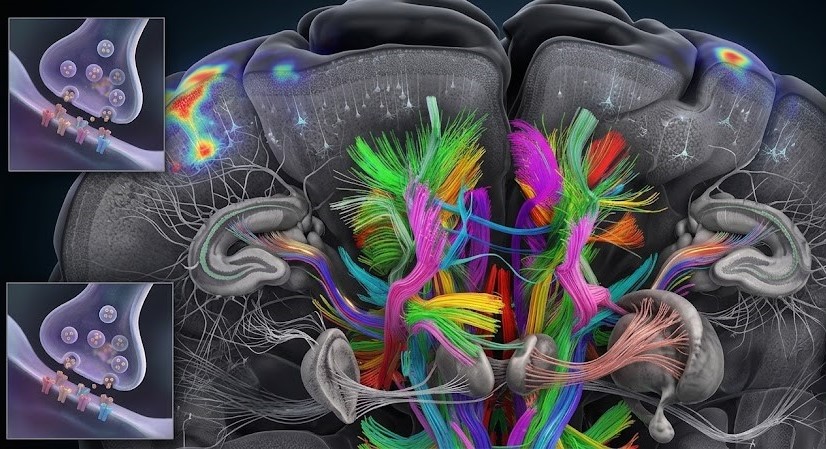
Visualizing Brain Scans and Models in Planetarium Domes (PoC)
A digital planetarium offers something unique:
Imagine beginning under a familiar night sky before diving into the retina, following visual signals along the optic nerve, traveling through the thalamus, and finally witnessing billions of neurons communicating across the cerebral cortex. This type of immersive narrative creates a powerful connection between everyday experience and cutting-edge neuroscience.
The Brain Is Every Bit as Beautiful as the Universe
Astronomy has long captivated public imagination because it evokes wonder.
Neuroscience has the same potential.
- Immersion that surrounds the audience with living neural networks.
- A shared learning experience where hundreds of visitors explore together.
- Large-scale visualization of datasets impossible to appreciate on conventional displays.
- Emotional storytelling that transforms abstract neuroscience into an unforgettable experience.
Inside a dome theater, audiences don't simply observe the brainת they experience it from within.
The human brain contains approximately 86 billion neurons connected through trillions of synapses, forming one of the most intricate structures known to science. Modern imaging reveals colorful neural pathways, branching dendrites, dynamic activity patterns, and vast communication networks that rival the visual grandeur of galaxies and nebulae.
The challenge has never been the beauty of the data. The challenge has been presenting it in a way that audiences can truly experience.
Planetariums solve this problem by replacing passive observation with immersive exploration.
Creating Emotional Connections
Science communication is most effective when it creates emotional engagement alongside factual understanding.
Immersive environments naturally foster that connection.
Visitors who travel through a beating heart, descend into a living cell, or navigate neural circuits gain more than information, they gain perspective.
Neuroscience becomes personal because every audience member carries the subject of the presentation inside their own head.
This emotional relevance makes brain-focused planetarium shows particularly powerful for:
- Schools and universities
- Medical education
- Public science festivals
- Museums and science centers
- Healthcare outreach programs
- Brain awareness campaigns
- A New Audience for Planetariums
Expanding beyond astronomy opens exciting opportunities for planetariums and science centers.
Adding neuroscience programming allows dome theaters to broaden their educational offerings while attracting repeat visitors interested in new scientific experiences.
Interactive Brain Experiences
The future extends beyond passive films:
Emerging technologies are making it possible to combine immersive dome projection with real-time scientific data, interactive simulations, and even brain-computer interfaces.
Research projects have demonstrated how EEG signals and immersive dome projections can create educational and artistic experiences where audiences visualize brain activity in real time. Early evaluations found participants reported stronger engagement, learning, and immersion compared with more conventional educational methods.
As visualization technologies continue to evolve, planetariums can become interactive laboratories where visitors don't simply watch neuroscience - they participate in it.
Successful neuroscience shows use immersive design principles to create journeys that feel natural, informative, and inspiring.
Building the Next Generation of Planetariums
As digital planetariums continue expanding beyond astronomy, neuroscience represents one of the most exciting new content categories.
Emerald planetariums are uniquely positioned to support this evolution by creating immersive environments capable of displaying high-resolution scientific visualization, interactive content, and multidisciplinary educational programming.
The future dome theater is no longer limited to exploring outer space.
It is becoming a gateway to every frontier of science, from the deepest reaches of the universe to the extraordinary complexity of the human mind.
The next great journey begins not among the stars, but within ourselves.